How to weave without a loom
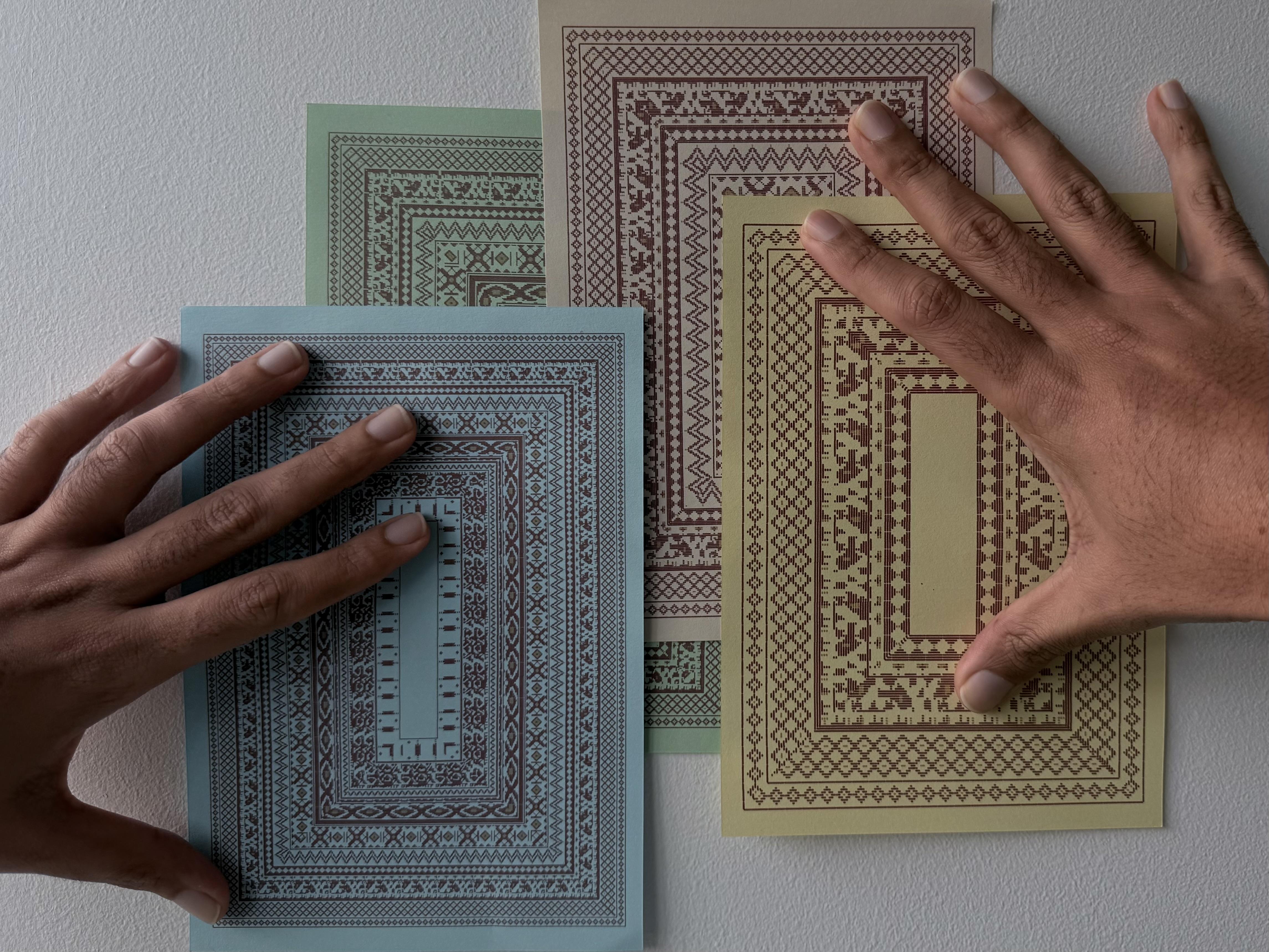 Some of the borders I developed and printed this week.
First, thank you. I sent last week's post out not knowing if anyone was on the other end, and it turned out some of you were. Thank you for reading it, for subscribing to a thing that is so far one post long, and especially to the few of you who wrote back. Some of it clearly landed, and a few of you said you wanted to read more, which I had quietly hoped for. I should be honest, though: the primary reason I write these is for myself, to put down what I make and notice before it slips past me. That some of you want to read along is a happy surprise on top of that, and reason enough to keep at it properly. I'm glad you're here. Here is week two.
Picture two weavers side by side at a pit loom in a courtyard near Dhaka, a little over three hundred years ago. The cloth on the loom is so sheer it hardly throws a shadow. With slips of fine bamboo they lift a few warp threads at a time and darn an extra thread through by hand, following a design pricked out on paper and laid beneath the warp, reading the pattern up through the threads. Between them, a border grows in the cloth, one motif at a time. The finest Dhaka muslins carried poetic names: abrawan (আবরাওয়ান / आबरावान), running water, because in a stream the cloth nearly vanished; shabnam (শবনম / शबनम), morning dew; nayansukh (নয়নসুখ / नयनसुख), pleasing to the eye.1
The cloth is muslin, malmal (মলমল / मलमल), and the flowered version the two of them are making is jamdani (জামদানি / जामदानी), a figured muslin. The name is Persian, adopted under the Mughals; the cloth was first called simply Dhakai, after the city of Dhaka. Its meaning is argued, and both readings survive: from jām and dānī, a vase of flowers, after the floral motifs; or from jama and dana, a sprigged or spotted cloth.2 Into the sheerest malmal the weaver darns small dense blossoms, butis (বুটি / बूटी), entirely by hand. The Mughal court could not get enough of it, and for a couple of centuries the karigars (কারিগর / कारीगर), the craftsmen, of Bengal were among the most prized textile artists alive.3 Emperors wore Dhakai (ঢাকাই / ढाकाई) muslin, and it travelled to Europe as a great luxury.
That sheet beneath the warp is the thing to pause on. The design, the naksha (নকশা / नक्शा), is drawn on graph paper, a grid of little squares, some filled and some left bare, and the weaver's whole task is to make the threads obey it.2 The pattern is born on a grid, counted square by square, long before anyone thinks to call it mathematics. A single sari can take a month or two of this, thousands upon thousands of tiny yes-or-no decisions, every one of them a chance for a tired hand to slip. Hold that thought, because the way the cloth survives those slips is something the rest of us did not write down properly until 1948, and I did not see it until this week.
The machines ended the first chapter. In the nineteenth century the mill cloth of Lancashire arrived by the shipload, cheaper than any hand could match, and the handloom towns fell silent as a generation decided their children should do something steadier. The finest cloth ever woven was all but extinguished in a few decades.4 It survived only in a handful of stubborn villages, in families who would not let the counting go. In 2013, UNESCO put the traditional art of jamdani weaving on its list of the world's intangible heritage,5 which is the modern way of admitting we noticed, just in time, that we had almost lost it.
Jamdani is really a craft of Bengal, and Bengal is now two countries. Its heartland today is Narayanganj in Bangladesh, on the bank of the Shitalakshya, and that is the tradition UNESCO inscribed. But after the Partition of 1947, weavers of the Basak community, descended from Dhaka's old muslin makers, migrated west and carried the craft into West Bengal, where it took root around Burdwan and blended with the Shantipuri loom.6 A silk cousin of the cloth, Uppada jamdani, is woven far to the south in coastal Andhra Pradesh and holds its own Indian geographical-indication tag.7 It is one craft, now split across a border that was drawn long after the cloth was already old.
I met the cloth from a different end, as a problem I made for myself to solve. I am making something for an upcoming event, and I wanted its borders to be true jamdani and not a clip-art impression of it, so I decided to develop the patterns, and particularly framed borders rather than trace them. That meant learning to read a border, a paar (পাড় / पाड़), the way the loom reads it. I spent most of this week's evening with photographs of old borders open on one screen and a blank grid on the other, and slowly worked out the mathematics underneath.
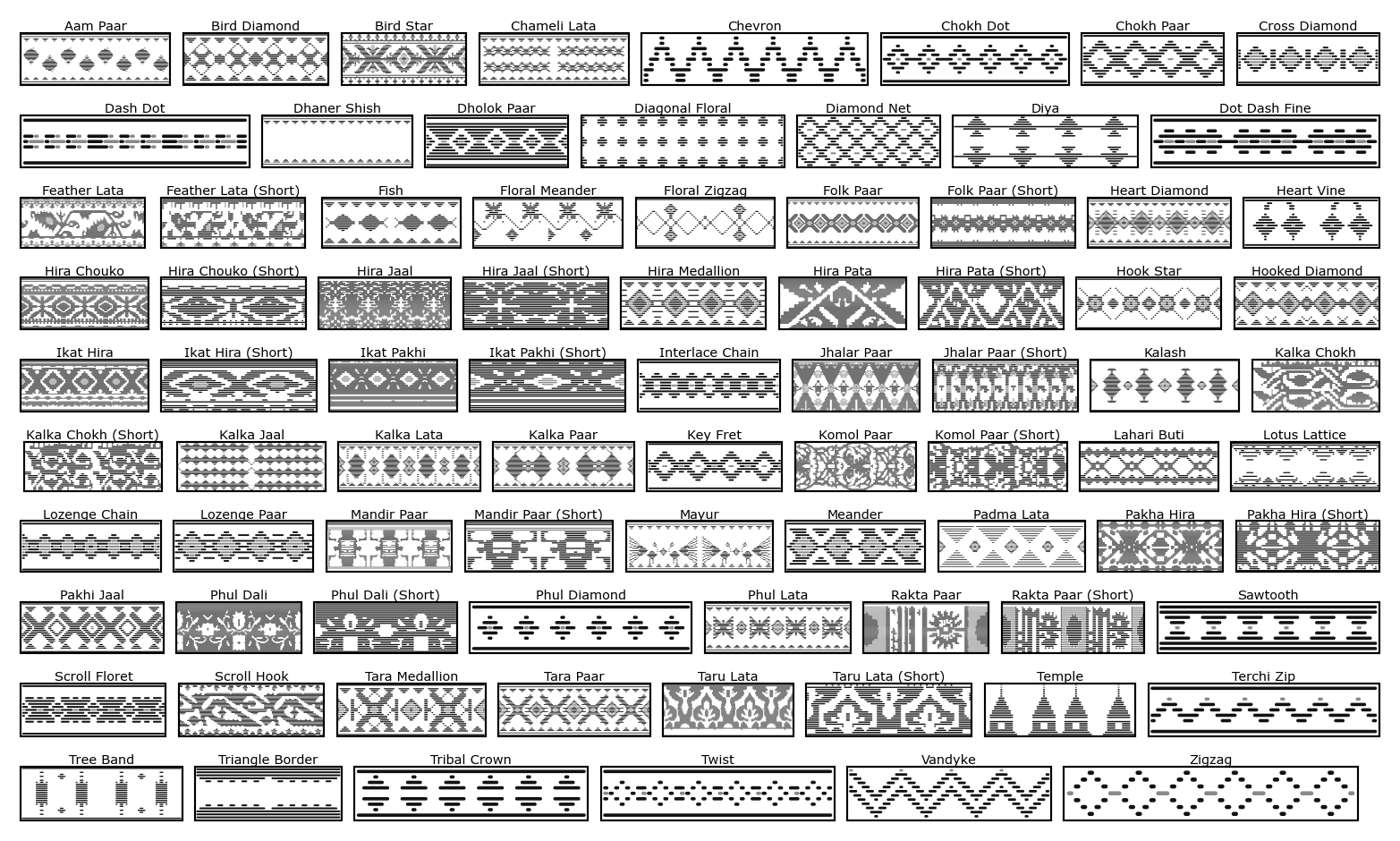 A page of the border vocabulary, each one named: aam paar, bird diamond, kalka lata, phul dali, tara medallion, chevron. Every one is built from cells on a grid, and named crudely, by my limited understanding and by what each most resembles.
The loom thinks in squares, the very squares of the graph paper under the warp. It carries the lengthwise threads, the tana (টানা / ताना), and the weaver drives the pattern thread across them, the poren (পোড়েন), bana (बाना) to a Hindi speaker, and at every crossing the answer is fixed and discrete: bare ground, a covering thread, or now and then a thread of accent in gold or silver. There is no halfway, no fraction of a stitch. So a motif is really a function on a grid of whole numbers, zero for ground, one for thread, three for an accent; and may be more than that if intended:
A buti can look as though it is made of smooth curves, but the loom cannot draw a curve. It can only fill a square or leave it bare, so the real edge is a tiny staircase of cells. The curve is something your eye adds. And once you see a flower as a matrix, the shapes sort themselves into a small alphabet. Stand at the centre of a motif and count outward, steps sideways and steps up. A diamond is every cell you can reach on a fixed budget if you travel like a taxi that can only run along the streets and never cut a corner:
Change the rule to the larger of the two distances and the diamond fills out into a solid square; set the two equal and you are left with the crossed diagonals of a star:
A terchi (তেরছি / तिरछी), the slant that runs through so many borders, is simply the line that climbs one row for every column, a staircase standing in for a slope. A kalka (কলকা / कलका), paisley or boteh; a mayur (ময়ূর / मयूर), the peacock; a jaal (জাল / जाल), the net ground that holds the others; the panna hajar, a whole "thousand emeralds." Each is a few of these lattice rules laid side by side, and the entire named lexicon is, underneath, distances on a grid, which is a small, old branch of geometry in its own right.8
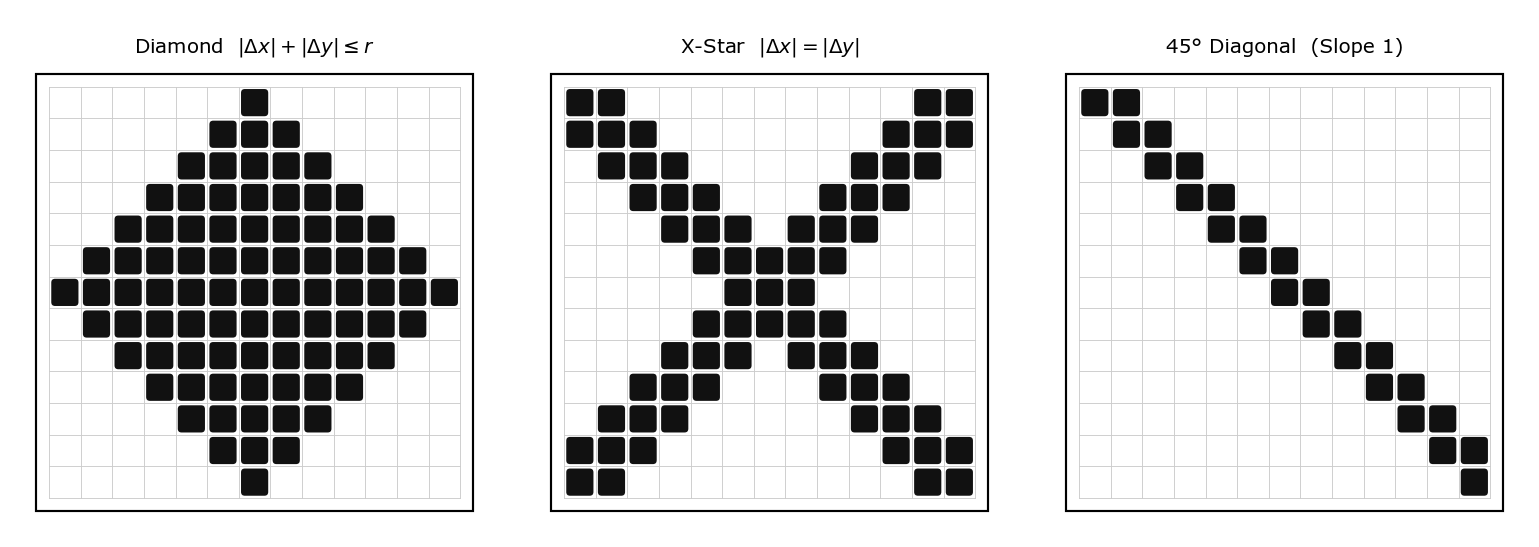 What your eye calls a diamond is, to the loom, every cell within a fixed taxicab distance of the centre. Change how you measure distance and the same idea becomes a square, or a star.
The borders hide something better still. A border is one figure repeating along a line, and more than a century ago mathematicians proved that there are exactly seven ways a strip like that is allowed to be symmetric. Not roughly seven. Seven, and the list closes forever.9 Every border that genuinely repeats along its length, in any century and any culture, is built on one of those seven symmetries. The weaver, flipping a motif across a line and sliding it along, is choosing among seven possibilities without ever being told there were only seven. And the symmetry is stricter than it looks. If a motif is mirrored down its middle and then repeated with period , a second mirror line appears on its own halfway between repeats, at the seam, for free. The pattern matches itself the same distance either side of that seam, so a mirror lands every half period whether anyone intends it or not, a corollary the arithmetic supplies on its own.
From here on I am honestly off the edge of the tradition, and what follows is my own construction. A sari carries a border down its sides and a worked end-piece, the aanchal (আঁচল / आँचल), but it does not frame a rectangle, and I have not been able to find whether weavers turn a real mitred corner or simply rotate the cloth to make one. I needed a frame with four corners for the thing I am making, so the corner that follows is mine, not something I can claim the cloth does. On the grid that corner is nothing fancier than the pattern reflected across its own diagonal, the cell at one position sent to its mirror, which is just the transpose of the matrix. The two arms of a border meet cleanly only when the corner falls on one of those free mirror lines, which happens only when the edge runs a whole number of half periods.10 So the length of a paar is not yours to pick freely. The maths tells you where you are allowed to stop. At the wrong length, the corner cuts a kalka in half, and there is no hiding it.
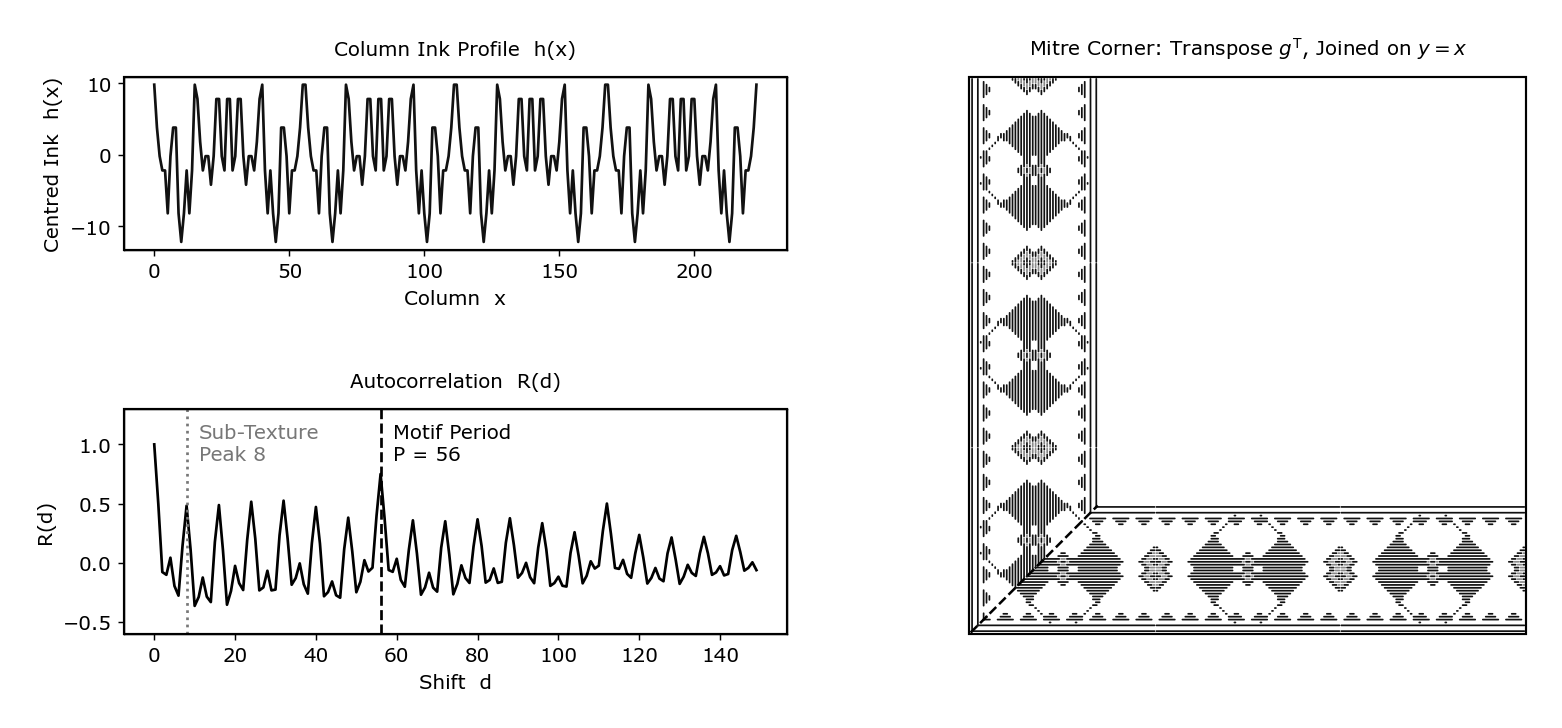 Right, a border turning a corner: on the grid the turn is just the pattern transposed and joined along the line y = x. Left, the way you find the repeat in the first place, by sliding a strip against itself, where the true motif period can hide beneath a louder, finer sub-texture.
Now I can come back to the question I left hanging at the loom, though this part is my own speculation rather than anything I can source. How does a pattern stay itself when every stitch in it is darned by hand, by a tired hand, a thousand times over? Stitches get dropped and threads miscounted, and yet the figure still comes out clean. My guess is that the answer is the symmetry. A jamdani motif is usually mirrored, so every stitch has a partner across the centre line meant to match it, and the busier motifs carry two partners more, four copies of each cell. When a hand slips, the matching copies outvote the mistake. If a weaver errs with probability , about one stitch in twenty, a lone cell is wrong with that chance, but four cells that should agree are all wrong together only about , one time in four hundred. Fold more aligned copies together and the noise falls like one over the square root of their count:
The pattern carries its own correction folded inside its shape. Claude Shannon set this out for radios and telephone lines in 1948,11 redundancy as a defence against noise, the trick that lets a garbled message still arrive correct. The weavers had been running it for three centuries before he wrote it down, if my hunch is right. It is how the design survived all those hands, and the decades when the looms went quiet, intact.10
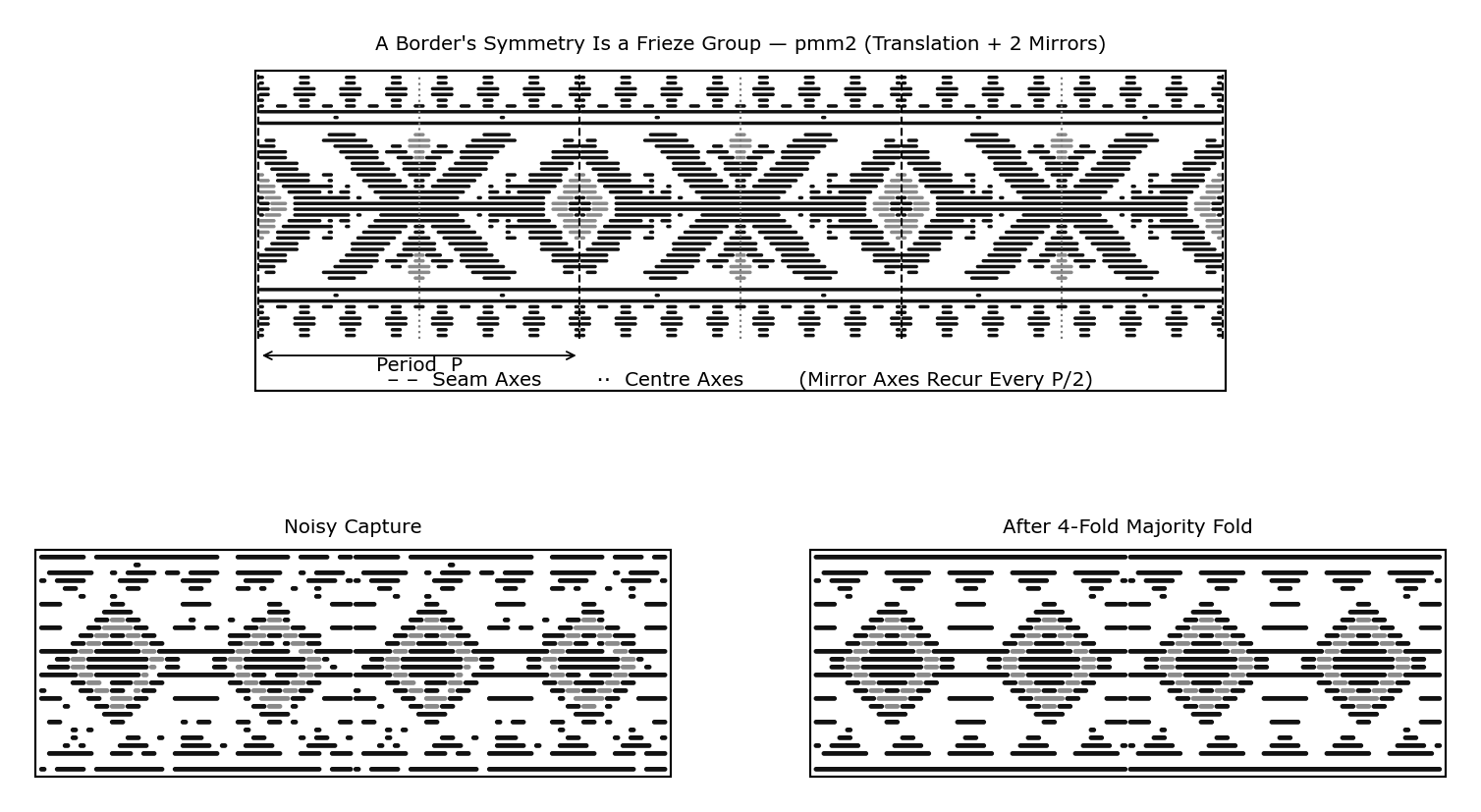 Top, a border and the mirror axes that recur every half period. Bottom, a noisy capture on the left, and on the right the same pattern after its four symmetric copies have voted the errors away. The symmetry is how the cloth repairs itself.
There are a few hard limits on all this. You cannot recover a detail finer than the source ever captured, so a low-resolution photograph caps how much real pattern you can pull back. A border also has two independent scales, its thickness and its repeat length, so to widen a band you tile the unit a whole number of times rather than stretch it out of shape. And the printer sets a floor of its own: a cell can be no smaller than its finest line, and where a fine technical printer holds a hairline around two hundredths of a millimetre, the home inkjet I am using bleeds to ten times that, which is why I keep everything vector and leave the final size open until it prints.
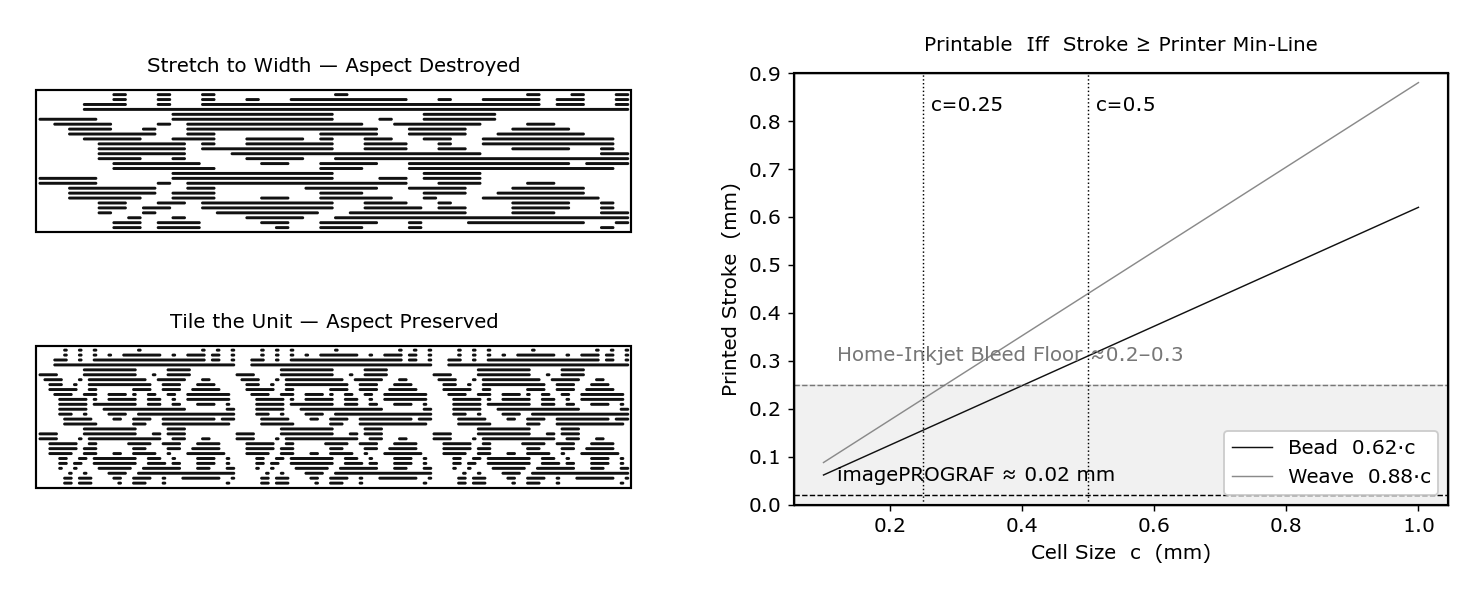 Left, widen a border by repeating the unit, not by stretching it. Right, a thread prints only when its stroke clears the printer's finest line.
I learned to read a cloth that almost did not make it as far as me. Weavers kept the counting alive through the bad years, and it reached me on the other side of the world. It is on my screen now as a grid of ones and zeros, and it is going to become a border for an event I have coming up.
That was the part of my week that had nothing to do with my job. The other could not have looked more different: a paper of mine came back provisionally accepted a few days ago, one that grew out of an older one of ours.12 It starts from something I find quietly unsettling. When engineers turn one of these learning machines loose on a physical thing, a material, a bridge, a medical scan, they cannot feed it the thing itself. They have to turn it into a picture or a list of numbers first. Which quantity to draw. Where to crop it. How hard to threshold it into black and white. What to call one category and what to call another. Every one of those is a decision, and each decision throws a little of the world away before the model has seen anything at all. In practice almost nobody writes them down. They get filed under "implementation detail," and then the machine's verdict is read as though it came from the material itself, rather than from one particular way of drawing it.
The paper is an attempt to make those choices visible, and open to question, before the training starts. It sorts them into four families: what you choose to show, how you lay it out in space, what you allow to vary, and where you draw the line between one category and the next. To each it attaches a few plain questions, and a single page on which to record what a choice kept and what it quietly threw out. I called it visual-mathematical literacy: the ability to read a representation, to see what a chosen picture of the data assumes and leaves out before you trust what the model does with it. I worked it through on a model that sorts auxetic structures, the odd lattices that grow wider when you pull on them, by the way they buckle. It looked like a clear success, until you ask where its grades came from: a clustering algorithm had carved the deformations into eight groups when the physics intended six, and two real behaviours never showed up at all. The score measured loyalty to one drawing of the question, and said almost nothing about how the material actually moves.
What I will say is that this is the first piece of work where my odd mix of trades helped rather than got in the way. More on it when it is published.
The rest of the week was ordinary in the best way. I finally got two things at work merged that had been hanging over me for longer than I would like; neither is properly finished, just off my desk and into the shared branch, with another two weeks of fixing them ahead, but the relief of having them out of my hands is real. At night I kept picking at Paul Davies' Quantum 2.0, though I lose the thread easily and may have to start chapter three over again.
Constraints are not the enemy of making. The loom can only say yes or no, and that narrowness is exactly why its patterns last, why they can be repaired, and why they survived four hundred years of imperfect hands. Give yourself a small enough grid and the work half holds itself together.
See you next week.
A disclaimer, because it matters. This is built on my own crude, outsider's understanding of jamdani, gathered over a single week of reading and staring at borders. I am a programmer who fell down a rabbit hole, not a weaver and not a historian. If you know the craft properly and I have got something wrong, I would genuinely rather be corrected than flattered.
Poetic names of the finest Dhaka muslin grades (abrawan, "running water"; shabnam, "morning dew"; nayansukh, "pleasing to the eye"): "Muslin," Banglapedia. https://en.banglapedia.org/index.php/Muslin↩
The technique (discontinuous supplementary weft darned in by hand on a pit loom, worked from a sheet of graph paper set under the warp), the name and the two etymologies: "Jamdani," Wikipedia https://en.wikipedia.org/wiki/Jamdani; "Jamdani," Banglapedia https://en.banglapedia.org/index.php/Jamdani; Victoria and Albert Museum, Explore the Collections, Jamdani / Dhaka muslin https://collections.vam.ac.uk/search/?q=jamdani.↩
Mughal patronage, court grades (mulmul khas, sarkar-i-ali) and the standing of Bengal's weavers: "Jamdani," Banglapedia. https://en.banglapedia.org/index.php/Jamdani↩
The nineteenth-century decline under cheaper European yarn and lost patronage, and the collapse of exports to 1817: "Jamdani," Banglapedia; "Jamdani," Wikipedia. https://en.wikipedia.org/wiki/Jamdani↩
UNESCO, "Traditional art of Jamdani weaving," Representative List of the Intangible Cultural Heritage of Humanity, 2013 (element 00879) https://ich.unesco.org/en/RL/traditional-art-of-jamdani-weaving-00879; and Jamdani Sari as Bangladesh's first Geographical Indication, 2016: The Daily Star, "Jamdani finally gets recognition." https://www.thedailystar.net/frontpage/jamdani-finally-gets-recognition-1316581↩
The post-1947 migration of Basak-community weavers to West Bengal, the Burdwan tradition, and the blend with the Shantipuri loom: "Tangail sari," Wikipedia https://en.wikipedia.org/wiki/Tangail_sari; The Textile Atlas, "The Delights of Jamdani Weaving." https://www.thetextileatlas.com/craft-stories/jamdani-weaving↩
"Uppada Jamdani Sari," Wikipedia. https://en.wikipedia.org/wiki/Uppada_Jamdani_Sari↩
Taxicab (L1) geometry: E. F. Krause, Taxicab Geometry: An Adventure in Non-Euclidean Geometry (Dover, 1986).↩
The seven frieze groups, the discrete symmetry types of a one-dimensional repeating strip: "Frieze group," Wikipedia; J. H. Conway, H. Burgiel and C. Goodman-Strauss, The Symmetries of Things (A K Peters, 2008). https://en.wikipedia.org/wiki/Frieze_group↩
The lattice loci, the half-period mirror result, the transpose-corner condition, and the reading of motif symmetry as error-correction are derived, and the figures generated, in my own jamdani toolkit.↩
C. E. Shannon, "A Mathematical Theory of Communication," Bell System Technical Journal 27 (1948), 379–423. https://doi.org/10.1002/j.1538-7305.1948.tb01338.x↩
The earlier auxetic-ML pipeline the case study audits: G. Singh, R. S. Dhari and Z. Javanbakht, "Automated detection of deformation mechanisms in re-entrant honeycomb auxetics using machine learning," International Journal of Protective Structures (2024). https://doi.org/10.1177/20414196241281069↩