One haloumi bagel toasted, cut into two
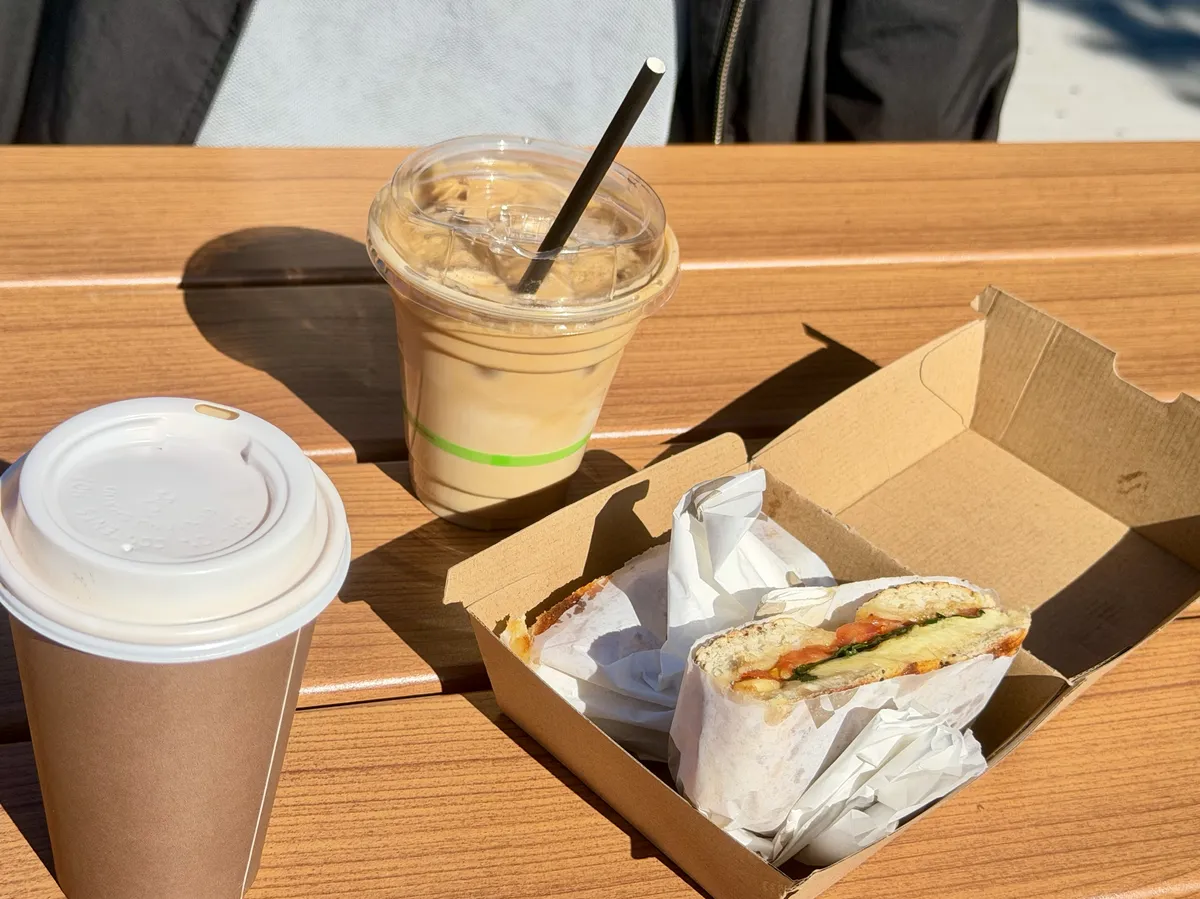 The table, most Saturdays. One of these coffees is the same every week and one of them never is. The bagel does not vary.
There is a cafe about ten minutes from the house and we have gone there almost every weekend for the last three fortnights. We did not choose it for being the best cafe on the coast. We sit on whichever side has the sun. A has ordered the same coffee every one of those mornings and has not looked at the board since the first. I try something new almost every week, on the theory that one of them will turn out to be better than the last. A orders for both of us. One haloumi bagel, toasted, cut into two.
We sit for half an hour. Sometimes longer.
I can tell you what we talked about last Saturday. I can tell you what the light was doing, and which dog was under the next table, and that we stayed long enough for the sun to move off the table and neither of us suggested going.1 People bring dogs. I could describe every dog.
I cannot tell you one thing about last Tuesday.
This is the part I have been turning over. Not that the weeks are hard, because they are not especially hard. It is that they are going somewhere I cannot follow. Monday happens, and then it is Friday evening, and I am waiting for a weekend which behaves the same way, and then it is Monday again. I would have said the days are going quickly and left it at that.
But days do not go quickly. Nobody in the history of Tuesdays has felt one go quickly while inside it. Tuesday took the full amount of time that Tuesday takes, hour after standard hour, and I was present for every one of them. The speed is not something I experienced. It is something I worked out afterwards, when I tried to account for the week and could not.
What makes the cafe strange is that it is the same cafe. The same table if we get there early enough, the same bagel, the same hour, week after week. By every rule I thought I understood about memory, those mornings should have collapsed into one another the way the Tuesdays have. Repetition is supposed to blur.
They have not blurred. I have them separately. I could sort them.
On Saturday afternoon we went to a bookshop, which is the other thing we do.
We are slower in bookshops than we are anywhere else. We separate at the door. A goes to fiction and stays inside it, crime and mystery and thrillers, working along the wall reading first pages, only first pages, and she can put a book down in about eleven seconds and will not be argued with on the point. She is answering the only real question a bookshop asks you, whether you actually want to read this. Almost nobody puts it to themselves. It takes me fifteen minutes and two aisles.
I am in every row there is. I pick something up, decide against it, put it back, wander off, and come back for it later as though the idea were newly mine. We do not see much of each other until the end.
It takes about an hour. We leave with one book each. Occasionally two, and there is a small guilt attached to two.
That hour is among the best of my week, and for a long time I could not say why, because nothing is produced in it. I could have bought the same book in forty seconds from the sofa and the book would be identical and the afternoon would have stayed free for something more deserving.
The book comes home and goes on the shelf, where eleven others are waiting, all chosen with exactly the same care.2
There is a Japanese word for this, tsundoku, for buying books and letting them pile up unread.3 Somebody went to the trouble of naming it, so it is not just us.
There is a reading of all this I have been walking around. Perhaps the bookshop hour is not attention at all. Perhaps choosing the book is the enjoyable part of reading the book, and we have found a way to have that part without the three hundred pages, and the shelf is not a queue of intentions but a record of eleven good afternoons and eleven things we did not do. I do not think that is the whole story. I no longer think it is none of it.
But it does not explain the cafe. Nothing is chosen there and nothing comes home with us, and the cafe is the part I cannot get around.
Reading is not unpleasant. I love reading. On the rare weekend I get properly inside a book I am happier than I am doing almost anything else. For a while I thought the difference was effort, that choosing is light and reading is heavy. It is not. The bookshop hour is not effortless. We concentrate the whole time and come out of it slightly tired.
The difference is that a bookshop only has one thing in it.
There is nothing else available in a bookshop. You cannot half-read a first page while also answering a message, or walk the fiction wall while also checking whether the thing from Thursday resolved itself. The space has removed the options. So for one hour on a Saturday, A and I are doing one thing. Discipline has nothing to do with it. The room decided on our behalf. I have written before about rooms deciding things for the people in them, and I thought at the time I was writing about houses.4
Here is what I keep hoping I will do: travel, paint, read, draw, live slowly.
Here is what I do: work, feel anxious about work, and arrive at Friday without having done the work I actually meant to do.
I wrote those out one evening without arranging them and only afterwards noticed the middle item on the second list, standing there like something that had walked in behind the others. Being anxious about work is not the same as working. It is its own line. It takes real hours, hours I could count if I were willing to, and it produces nothing.
I had always understood the exchange as: I do not paint because I work. That is a fair exchange and I would sign it. What actually happens is that I do not paint, because I work, and worry about work, and then Friday comes and the work is undone as well. Nothing was purchased. The hours went and brought nothing back.
It took the car to explain to me why the worrying is so expensive.
When the drivetrain warning came up on the motorway I was frightened, and I want to be accurate: the fright was almost restful. It was about something. It had a name, a likely cause, a next action. I looked it up, I decided to get it scanned, and the feeling drained the moment it had somewhere to go.5
Anxiety will not do that, because it is not about anything. I do not mean that loosely. That is the actual difference between the two.6 Fear points at something. Anxiety is the pointing with nothing at the end of it, an alertness that has come up from underneath and cannot say what for. When I am anxious about work and A asks what specifically is wrong, I have never once managed an answer, and for months I took my inability to answer as proof I was being ridiculous. It is not proof of that. It is the definition.
Which is why it consumes days without marking them. Fear at least leaves you a Tuesday in which something occurred. Anxiety leaves you a Tuesday spent braced against nothing in particular for six hours, and bracing leaves no trace, and afterwards there is nothing there to find.
So I had an explanation for the vanishing weeks. They are made mostly of something that does not record. Work blends into work, a Tuesday in March is indistinguishable from the Tuesday before it, and worry stores worse than anything because worry has no content and you cannot lay down a memory of an absence.
But that explanation predicted the cafe would blend too, and it has not.
I had assumed the mornings I keep are the unusual ones, that memory runs on novelty, and that this is why people come back from two weeks away feeling they have lived more than in the six months preceding it. There is something to that. But if novelty were the mechanism then the most recent Saturday at the same table would be a blank, and it is not.
For that half hour I am not doing anything else.
It is not the newness, and it is not the coffee. Not the sun either, though I would not give that up. The mornings stay because my attention has one place to be, and an hour with one place to be arrives somewhere and can be found again. An hour with several does not arrive anywhere.
The obvious objection is work, and I have to take it, because work is often one thing for hours together. I have spent whole afternoons inside a single problem with nothing else on the desk, and those afternoons are as gone as the rest of the week. So one place to be cannot be the whole of it. What those afternoons have, I think, is a second one hidden inside the first: whether the work is going to be good enough. That question runs the entire time and never gets answered. It is the one that eats the hour, and I never see it.
Nobody at the cafe is going to grade the cafe.
Which is where the two halves of this joined up, later than they should have.
An anxious hour and an open hour are the same hour. Not similar. The same. I have gone looking for something that separates them and I cannot find it. A free Saturday has everything available in it and nowhere in particular to be, and that is also the most accurate description I can give of what I have been calling anxiety. Alert, with nothing assigned to it, pointed at nothing because everything is equally there and nothing has been ruled out.
I had been treating the open hour as the reward and the anxious hour as the tax. I now think they are one thing described twice by someone who badly wanted one of them to be a holiday.
That would explain the sofa. It would also explain the bookshop, without either of them having anything to do with discipline. The sofa is not a failure of will. Every hour on that sofa contains the book, and the phone, and the other things I said I would do this weekend, and Monday, all of it equally available at every moment. The bookshop is not a place where I concentrate. It is a place where there is nothing to be anxious in the direction of.7
A started hers on Sunday morning, because she is better at that part than I am and always has been. I read mine the same afternoon, an hour of it, and I have not worked out what made that afternoon different. Ten books are still on the shelf.
I am not going to turn this into a system. I have converted three previous realisations into systems and then become anxious about maintaining the systems, which is a thorough way of losing the original insight. I can now say why that happens. A system is one more set of open options, and the options are the problem. What I need is not a method. It is a room with one thing in it, and the bookshop is proof that I manage one easily when the room does the deciding.
Next Saturday we will go to the same cafe. She will take the side with the sun. She will order her coffee and one haloumi bagel, toasted, cut into two, in the same sentence she uses every week. I will try something I have not tried. Nothing will happen.
I will remember all of it. I remember more of these mornings than she does, in more detail, and for a long time I took it as a small private credit, as though I had been handed a finer attention than hers. That was wrong. It is the finding. The person who can account for every one of those Saturdays is the same person who cannot produce a single Tuesday, and it is the same memory doing both. It is only a different room.
I wrote about the wedding and the Sydney trip last week and gave the cafe mornings about a line and a half, because at the time I thought the trip was the story. They have turned out to be the part I kept.↩
I counted, which I do not recommend. It is eleven. I had assumed about six. The gap between those two numbers is the part I keep coming back to.↩
積ん読, from tsunde oku, to pile something up and leave it, punning on doku, reading. The joke is built into the word, which is more than I managed on my own.↩
The long way round, the first of these letters, about leaving rooms and rebuilding them and what each one made easy or impossible. I thought that essay was about moving house. It appears to have been about Saturdays.↩
The scan is still not booked. I am aware of the irony of offering this as my example of a feeling that resolves cleanly into action, and I am leaving it in for exactly that reason.↩
I did not discover this. The distinction between fear, which has an object, and anxiety, which does not, is Kierkegaard's in The Concept of Anxiety (1844), and Heidegger keeps it as the difference between Furcht and Angst in Being and Time (1927), where the thing anxiety is about turns out to be nothing and nowhere. I arrived at it on a motorway with a warning light on, roughly a hundred and eighty years late.↩
In summer the pool is the other hour in my week with nothing else available in it. You cannot check anything mid lap. But I do not remember individual swims the way I remember individual Saturdays, and I have not worked out whether that damages the argument or only means I am bored in water.↩