Which half was mine to tell
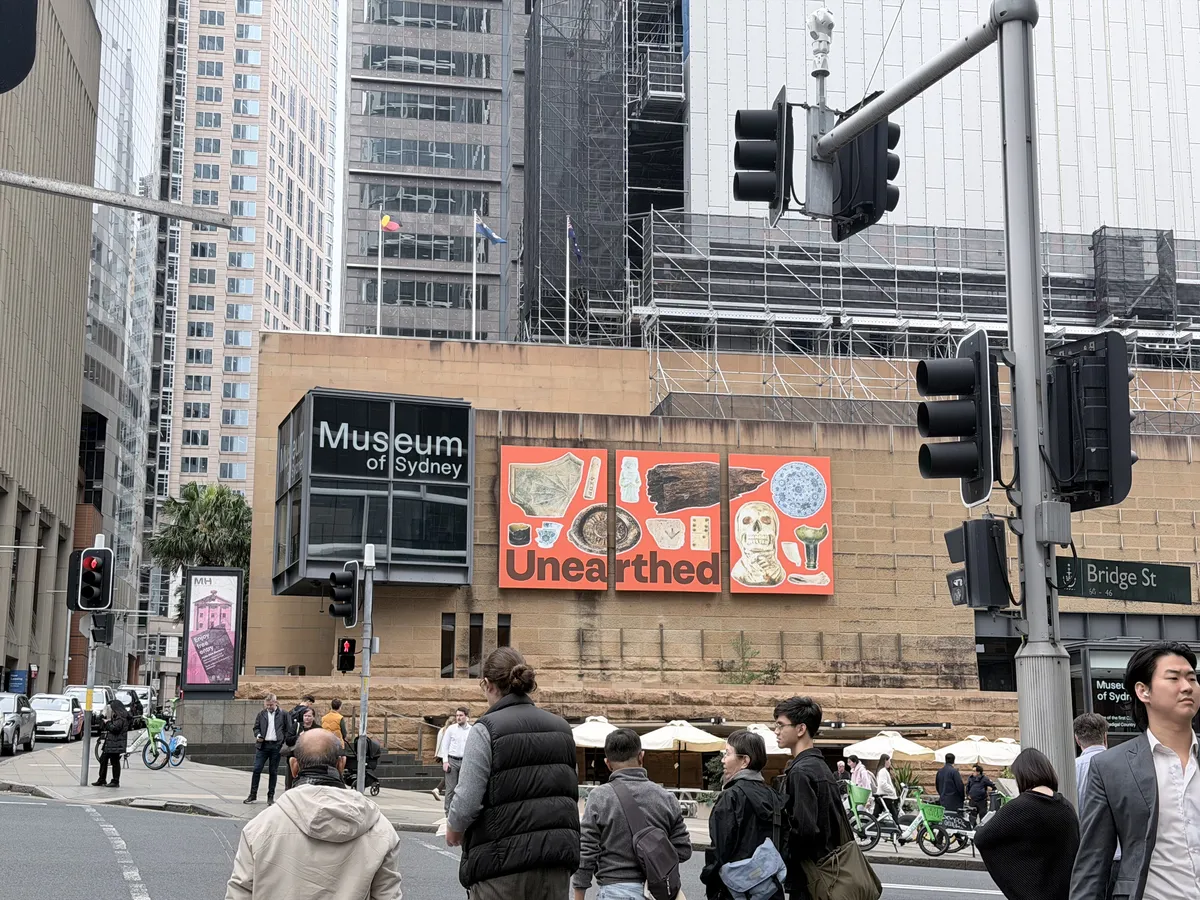 Museum of Sydney, corner of Bridge and Phillip, on one of the drier afternoons. The building sits on the site, and the exhibition is what was under it.
There's a book from 1884 called Flatland, in which a square explains his world to you.1 He lives on a plane. His eye is a single line, so he has never seen a square, including himself. Everyone else arrives as a segment that lengthens and shortens as it turns. Then one night something visits from a direction he has no word for, not north, not east, but up, and he spends the rest of his life trying to explain to people who love him that there's a way to move they can't point at.
I spent a month building a playable edition of that book.
The news first, because it's the best of it. A and I got married in July. People who write online either say nothing about a marriage or say far too much, and I'd like the narrow road between. She's the one I mentioned in June without naming, who waited up on a bad Thursday and made tea and didn't ask me to explain. Anyone who follows me on Instagram has been seeing her there for a long while, so for some of you this is less news than a formality. It feels good to say so here.
The weeks around it are still sitting in my head, which is most of why I'm writing this. Some things don't finish happening until you've written them down.
Much of that month happened in a language I don't have. It's like sitting inside music written in a notation you can't read. You get the dynamics and none of the melody. You know when a phrase swells, when it resolves, whether it was a question or an instruction, all from the way a room leans. What you never get is the meaning. After a while you stop reaching and let the sound pass through you, which is either patience or giving up, and I couldn't always tell which.
I was A Square in those rooms. Everyone had a direction I couldn't point at. They were kind about it and it didn't help, because kindness doesn't hand you a dimension. What I had was the segment view: length, pitch, volume, the shadow a meaning casts crossing your one line of sight. I got good at reading it. I was wrong a lot.
Here's what I only heard because everything else was so loud. A rest isn't an absence of music. It's a decision made inside it, and it takes the whole passage before to set the length. I've loved a certain quiet in A for years without once thinking what it cost to compose.
Most of what happened in those weeks belongs to other people, and I'm going to leave it with them. What I can give you is my own part, which is the less flattering half anyway.
For a stretch of days I was a guest somewhere I had every right to be. I won't explain the arithmetic. It made sense at the time and would probably make sense to you. What I remember is logistics. Our house is small and holds heat badly, which you don't notice until a Queensland winter gives you a reason to. I learned the shops here shut at five except Thursdays, a fact I've lived here happily without ever needing. I bought an air mattress from Bunnings on a Friday morning because A had been sleeping badly for days and hadn't mentioned it.
And I nodded. I nodded at a great many things I didn't agree with and called it respect. Some of it was. Some of it was easier, and I knew the difference at the time.
Once I asked A whether I could leave, just for a few hours. She said yes. I stayed anyway, and I still don't know which was the right answer.
None of it was a crisis. Nothing happened that would sound like much once set down. It was a fortnight of small things arriving daily, none of which anyone would apologise for.
What I came out with is a rule rather than a grievance. I want a house where two people decide things in front of each other, out loud, and change their minds where the other can see. It cost more to learn than it looks written down.
The rest I'm keeping. Working out which half was mine to tell has been most of the difficulty of writing this, and the game had already taught me how.
Flatland has a chapter about women that reads badly today, and read badly to plenty of people at the time.2 They're drawn as mere lines. Denied reason and memory and education, made to announce themselves with a cry, then blamed for the danger their confinement creates. The standard reading is satire and I think it's right: Abbott was a headmaster who argued publicly for educating women, and the narrator's smugness is the book's target as much as its voice. But satire delivered deadpan is easy to mistake for endorsement, and a game that reproduces the laws of a place without comment just inherits them. So my edition carries an editor's note saying that plainly, and a moment where a Woman speaks, which the original never once allows.
That note took me longer than any code in the project. The problem was never what I thought. It was working out what was mine to say, inside someone else's story, about people who couldn't answer back. I didn't know I was rehearsing.
The part I can say plainly is the thanks.
Almost none of that month would have held together without people under no obligation to hold it. A driver at midnight in an airport car park, working out with his hands and a few borrowed words what the two of us couldn't manage with a whole shared vocabulary. A friend who drove us three separate times, twice at hours nobody should be asked to drive. Family who came, and were a great deal more gracious than I managed to be. They've all been thanked already. I just wanted it written down somewhere I'll come back to.
Then, on the Thursday after, the four of us went to Sydney, A and me and her parents.
It rained every day. Never hard, never long enough to feel like an event. Just grey and steady from morning until dark, the sort of rain that makes an itinerary look like a joke you told yourself. We'd planned a city and got weather instead. The trip ran on gaps: an hour here, an afternoon there, the sky lifting exactly as long as we needed and closing once we were inside.
The best gap was the Opera House. We got there in the clear, and I watched two people who'd flown a very long way stand in front of a thing they'd only seen printed on other people's photographs. I think they loved it. It's hard to be jaded under those shells, and I liked being with people who weren't going to try.
The next evening A and I went down to the Quay, where the Bastille Festival was on and the waterfront had turned French for a few days.3 It was raining again. We sat under an umbrella with a Nutella crepe and listened to a woman singing, and neither of us was in a hurry to move. We'd come with no plan at all, which after that month felt like a luxury.
Then we took a ferry out, into a cold I still don't have the words for. The wind comes off that water at night and goes straight through everything you own. I'd recommend it anyway to anyone who thinks they know what a harbour looks like. The bridge from the water in the dark. The Opera House lit from the side. The city doing the thing cities do at night, where they briefly look designed. We stayed out on the deck the whole way.
We saw cathedrals, because A loves an old building and will stand in one corner of it after another, looking up. In the forecourt of St Mary's there was a Sistine Chapel at half scale, in the last week of a two month season.4 Not a model. A purpose built shell with the Vatican's own scans thrown onto it by projector, so you stand inside a temporary structure on a wet afternoon and the ceiling happens around you. I walked in ready to be snobbish and didn't manage it. A stood under the Last Judgement a long time, close enough to see brushwork that Rome keeps at a distance. Rome is still coming; when she stands in the real chapel she'll already know what she's looking at. This one came down to meet her first.
We went to Bondi and looked at a beach in the rain, which is its own kind of experience. The dogs were unbothered, the beach was full of them that day, and one Border Collie singled us out, dropping his ball at our feet with the certainty of a dog who has never once been refused. We threw, he retrieved, and for a few minutes the weather stopped mattering.
We spent an afternoon at the Museum of Sydney, which stands on the footprint of the first Government House, put up in 1788. The exhibition was Unearthed: a selection from roughly 140,000 objects dug out of that block between 1983 and 1991, after a century and a half under the street.5 Australia's first printing press, in pieces. Wine bottles reworked into cutting tools by First Nations toolmakers, an entire history in one object. Decorated crockery someone had hidden down a privy. I thought about my June letter, the abbot who printed a book arguing against printing, and how the press ended up in fragments under this city.
And at the Quay we found the Customs House library, a public reading room inside an old customs building, with a scale model of the whole city laid out under a glass floor you walk across on your way in.6
I stood on that model until the other three had wandered off and come back. Of course I did. I'd just spent a month building a world where the view from above is forbidden by law, and here was a city with its roof off. Every street solved, nothing hidden, and it told me nothing about being down there in the rain looking for somewhere to eat. The map is not the place.7
What struck me most was that Sydney felt old. Not by the measures I grew up with, where old means something else entirely. But old for here. It has layers and it knows it: the most contested block of land in the city is dug up and behind glass on Bridge Street, with the labels naming who lost. A city that's been a city long enough to stop apologising for it. A and I said at more or less the same moment that we'd like to live somewhere like that for a while. For a while. Neither of us said settle, and I noticed both of us not saying it.
The game is nearly there. The gameplay is done. It started as a single file and stopped being one a while ago, and what's left is logistics rather than design. A Victorian print edition you can play: journal column on the left, the plane on the right, drop caps and spot colours and a running head, and an economy where seeing the plate from above costs you something, because it should.
Two things surprised me about making it.
The first is that it turned out to be a writing project. Most of what I did was write. The journal, the editor's note, the lines the shapes say to each other when they bump. The code was the easy part, and I'm still adjusting to that.
The second is where the difficulty went. I built it with an AI sitting next to me, and the interesting part wasn't the speed. When a machine can produce any given piece on request, the scarce thing becomes knowing what you want, precisely enough to say out loud. That's where nearly all my time went. The bad sessions were the ones where I handed over a list of fixes instead of an intent, and got back exactly the list of fixes and a design slightly worse than before. In June I wrote about the danger of shipping something you couldn't have written yourself and calling it understanding. I still think that. The same warning applies to taste, which is much harder to notice going missing.
Back at the desk now, back to the counting and the paperwork and the tests, the long business of turning yourself into a number a system will accept.
Near the end of Flatland, A Square is teaching his grandson, and the phrase he keeps coming back to is "Upward, not Northward." He calls it the clue to the whole proof. The boy bursts into tears and swears he never said it, that it would be nonsense, that nothing could move upward and not northward, how silly it is.8 Which is the problem exactly. A direction the old map has no word for, no way to point at it, and you go anyway.
It's been four weeks since the last letter. The month explains most of it, but sorry all the same. The next few weeks, written down where I can be held to it: restart the skills assessment, which is stuck waiting on more documents, get back up to speed at work, and get back to the research, which has sat still just as long.
Weekly from here. I mean it this time.
See you next week.
Edwin A. Abbott, Flatland: A Romance of Many Dimensions, published pseudonymously as "A Square" (Seeley & Co., London, 1884). Abbott was a schoolmaster and Church of England cleric who wrote a great many serious books, of which this small one is the only one still widely read. Full text online at https://monadnock.net/abbott/.↩
Flatland, §4, "Concerning the Women." The satirical reading is the standard one: Abbott, as headmaster of the City of London School, publicly argued for the education of women, and the narrator's complacency is treated throughout as a fault rather than a virtue. When early readers took the chapter at face value, Abbott responded in a preface added to the 1884 second edition, in which A Square walks back his own earlier words. On the book's larger argument about language and new directions, see Elliot L. Gilbert, "'Upward, Not Northward': Flatland and the Quest for the New," English Literature in Transition, 1880–1920 34, no. 4 (1991).↩
Bastille Festival, Circular Quay and The Rocks, 16 to 19 July 2026, in its thirteenth year and free to attend. https://whatson.cityofsydney.nsw.gov.au/events/bastille-festival-2026↩
Sistine Chapel: Revelations, St Mary's Cathedral forecourt, 16 May to 19 July 2026, developed by the Catholic Archdiocese of Sydney with the permission of the Vatican Museums and ultra high resolution imagery from their archives, housed in a purpose built truss structure at roughly half the scale of the chapel in Rome. https://sistinechapelsydney.com.au/↩
Unearthed, Museum of Sydney, from 5 December 2025 and running through 2026, curated by Dr Aaron de Souza for Museums of History NSW. Around 140,000 artefacts were excavated between 1983 and 1991 from the site of Australia's first Government House, built 1788–89 for Governor Arthur Phillip, after about 140 years buried under the street. https://mhnsw.au/whats-on/exhibitions/unearthed/↩
Customs House, Circular Quay, built 1844–45, headquarters of the Customs Service until 1990, and home to a City of Sydney library since the 2003 refurbishment. The City Model sits beneath trafficable glass at the base of the atrium, roughly 4.2 by 9.5 metres, hand built and updated over more than twenty years, and lit at night by fibre optics along the streets. https://www.cityofsydney.nsw.gov.au/things-to-see-and-do/city-model↩
I wrote about this in June by way of Borges' one-paragraph story about an empire whose only perfectly faithful map was the size of the empire itself, and therefore useless. Apparently I needed to stand on one to believe it.↩
Flatland, §21, "How I tried to teach the Theory of Three Dimensions to my Grandson, and with what success." https://monadnock.net/abbott/flatland-21.html↩